
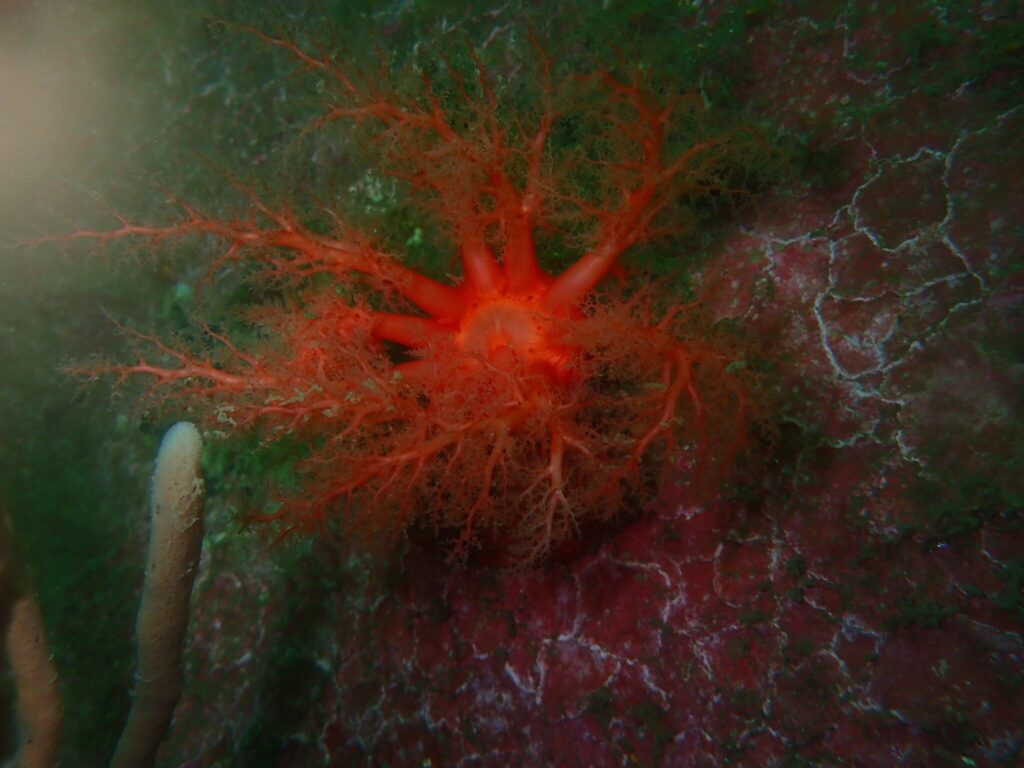
There are animals that can regrow lost limbs, such as the famous lizard’s tail. However, their old tail simply dies off and rots away. Not so the tiny feet and tentacles of the Scarlet sea cucumber (Psolus fabricii), a strange animal that lives on the rocks in the cold regions of the Atlantic and Arctic Oceans — not only can it regrow limbs lost to predators, but lost feet and tentacles are capable of surviving independently for more than three years, as recent research has shown.
The deep sea still harbours so many secrets and often resembles a terra incognita, or rather, a mare incognitum. To date, P. fabricii is the only known species in which lost tissue can continue to live. However, there must be a reason why this ability has been lost in the course of evolution; otherwise, at least some subsequent species would exhibit similar behaviour with regard to lost body parts.
I’d like to subscribe to the think.fish newsletter
Once research discovers what prompted evolution to abandon this ability, and how it might be replicated, would it then be possible to lose a limb, let it grow back, and later reattach it to its original place – perhaps a finger, an entire arm, or even a brain? Perhaps it was right that evolution cut short this path before humanity could even think of it…
Oh no, too late – ’future research into this phenomenon could have important implications for regenerative medicine,’ the researchers believe.
Reference:
Science (2026): ’Natural tissue immortality: Indefinite survival of sea cucumber explants’
Schreibe einen Kommentar
Du musst angemeldet sein, um einen Kommentar abzugeben.