
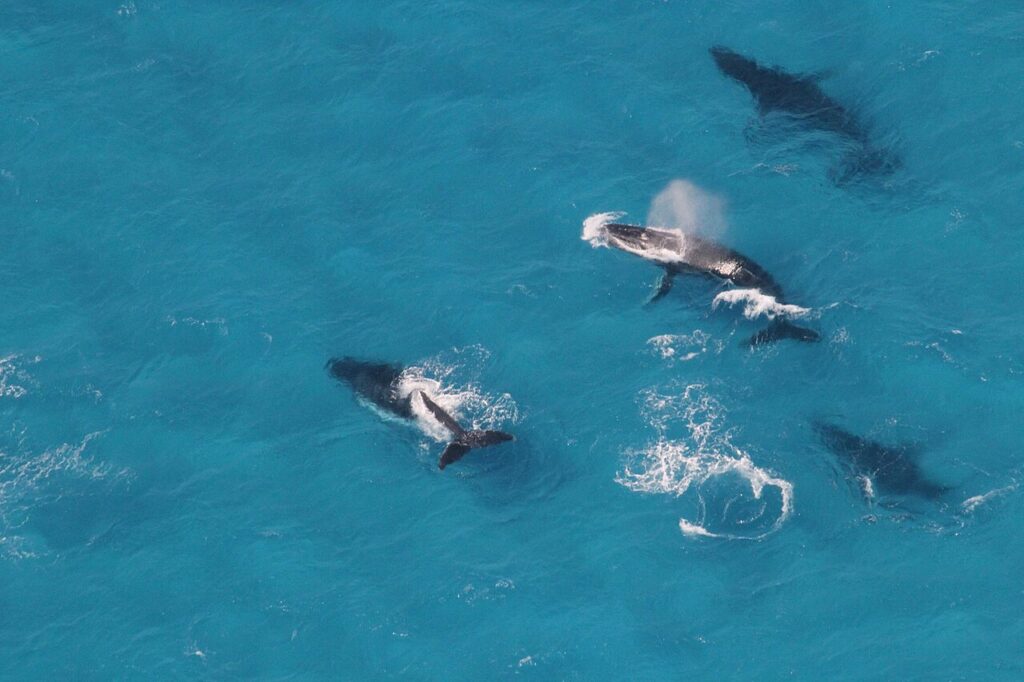
As we’ve been talking a lot about one particular whale recently, here’s some news about lots of other whales.
animal suffering Animal welfare artisanal fisheries ASC Badetourismus Betäubung Blauhai bottom trawl bycatch Canada Carefish/catch Catch Welfare Plattform certification Chile China Cod consumer attitudes Danio rerio Don Staniford Erderwärmung EU evolution fair-fish fair-fish database Fischfutter Fischkonsum Fischmehl Fischwohl Fischzucht fish consumption FishEthoGroup fishing ban fish meal fish oil Fish stocks Fish welfare global warming Greenpeace greenwashing Grossbritannien Hummer Humpback whale ICSF India Intelligenz Kleinfischerei Kognition krill Label labels Lachs Lachszucht Litopenaeus vannamei local communities Marine Protected Areas (MPA) max. 1x im Monat Melander microalgae migration Mittelmeer MSC Norway Oktopoden Oman Omega-3 Ostsee Pacific whiteleg shrimp phytoplankton play Pole and line Rainer Froese RAS Ray Hilborn Reducing animal suffering Salmon Sandtigerhai Schweiz Scotland Senegal shrimps small-scale fisheries small scale fisheries stocking density Strand Strandschutz Swiss Shrimp Tierleid Tierschutz Tintenfische Tourismus trawler Tötung USA Wal Westafrika whales Whale shark whale song Überfischung ökologische Nische
Whales filter seawater to feed on krill, tiny zooplanktonic crustaceans. When the whales were decimated, it was assumed that the krill population would flourish, but in contrast, their population declined at the same time. A recent study by the University of Washington [1] found that whale excrement contains a significant amount of iron and non-toxic copper, both essential but scarce nutrients for phytoplankton, which in turn is the food source of krill. In other words, whales have always provided the basis for their own prey and that of many other marine animals. The critical role that whales play in the complex marine food web was jeopardised by industrial whaling.
On other places in space, there could also be life in the oceans, but it would not be easy to detect . A study at the University of Reading [2] suggests that the physics of alien oceans could prevent deep-sea life from reaching the surface for us to see. In the case of a moon of Saturn, its ocean forms layers that are so distinct that they slow the upward movement of material from the seabed. The absence of tangible biological signatures on the surface does not therefore mean that there is no life in an alien deep sea. Whether this is good news for billionaires exploring extraterrestrial havens is another question; for those who remain on Earth and depend on healthy oceans, the international ban on whaling is a glimmer of hope and should be defended against the greed of some nations.
PS: In Humpback whale songs, researches recently detected ‚the same statistical structure as human language‘. The assumption that language ability is reserved for Homo sapiens is obviously anthropocentric, professor Chomsky.
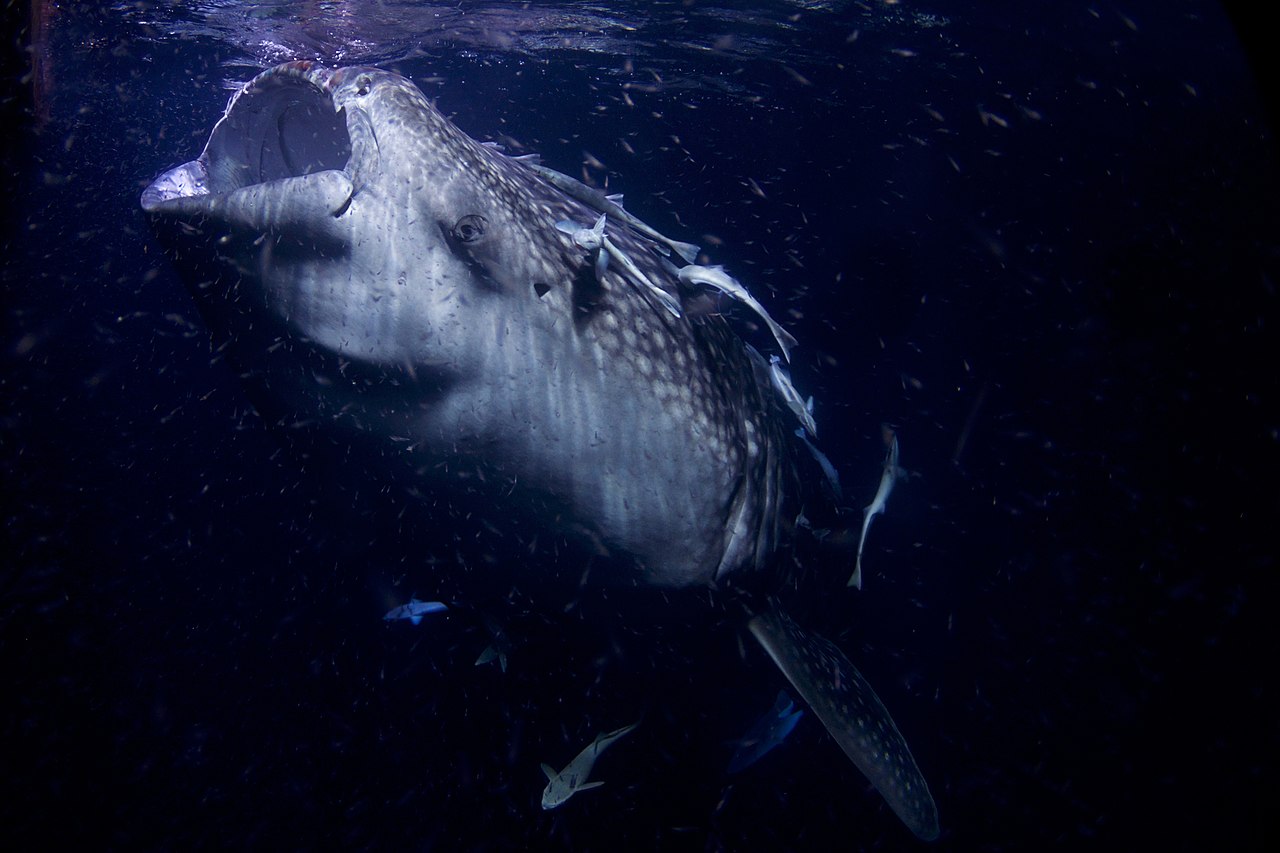
Title picture:
A Whale shark (Rhincodon typus) filter-feeding plankton at night (credit: Arturo de Frias Marques / Wikimedia Commons)
References:
[1] ‚Whale poop contains iron that may have helped fertilize past oceans‘, ScienceDaily, 06.02.2025
[2] ‚Alien ocean could hide signs of life from spacecraft‘, ScienceDaily, 06.02.2025
[3] ‚Humpback whale songs are structured like human language‘, Sience.org, 06.02.2025
animal suffering Animal welfare artisanal fisheries ASC Badetourismus Betäubung Blauhai bottom trawl bycatch Canada Carefish/catch Catch Welfare Plattform certification Chile China Cod consumer attitudes Danio rerio Don Staniford Erderwärmung EU evolution fair-fish fair-fish database Fischfutter Fischkonsum Fischmehl Fischwohl Fischzucht fish consumption FishEthoGroup fishing ban fish meal fish oil Fish stocks Fish welfare global warming Greenpeace greenwashing Grossbritannien Hummer Humpback whale ICSF India Intelligenz Kleinfischerei Kognition krill Label labels Lachs Lachszucht Litopenaeus vannamei local communities Marine Protected Areas (MPA) max. 1x im Monat Melander microalgae migration Mittelmeer MSC Norway Oktopoden Oman Omega-3 Ostsee Pacific whiteleg shrimp phytoplankton play Pole and line Rainer Froese RAS Ray Hilborn Reducing animal suffering Salmon Sandtigerhai Schweiz Scotland Senegal shrimps small-scale fisheries small scale fisheries stocking density Strand Strandschutz Swiss Shrimp Tierleid Tierschutz Tintenfische Tourismus trawler Tötung USA Wal Westafrika whales Whale shark whale song Überfischung ökologische Nische