
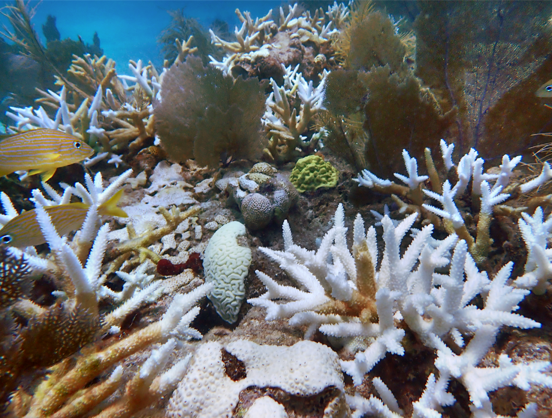
In an article worth reading on AEON, Iris Braverman comes to a simple but not so easy to implement conclusion: regulatory authorities, scientists, and local communities must work together to make coral reefs fit for rising sea temperatures.
As a professor of law, Braverman has studied the legal, social, and environmental issues inconservation and restoration projects. In her article [1], she describes the current situation of conflicting attempts to restore coral reefs.
Scientists believe they have found a stopgap solution: interbreeding corals from endangered reefs with more heat-tolerant corals from other reefs. But regulators are bound by national and international laws that restrict or even prohibit the removal of biological material or its introduction into another habitat.
In practice, approval of projects to strengthen reefs with improved corals often comes, if at all, too late, as the corals have died in the meantime. Scientists are therefore calling for a change in the laws, which they see ‛less a tool of protection than a barrier to survival’. On the other hand, regulators warn of the risk of long-term irreversible negative impacts and insist on ‘at least a generation of evidence of the concept’s effectiveness’.
I’d like to subscribe to the think.fish newsletter.
Braverman concludes that ‘the conflict between scientists and regulators isn’t just a technical dispute — it’s a debate about governance’. She advocates that local voices and their practical knowledge should also be heard in order to democratise science and ‘bridge the gap between caution and action’.
In other words, don’t forget the people on the ground, talk to each other and decide together – an approach that should be self-evident in any conflict over the use of a common good.
[1] ‘Red tape on a blue planet’, AEON, 09.01.2026 https://aeon.co/essays/should-we-intensively-alter-coral-reefs-so-they-can-survive-the-heat
Title picture: Bleached brain corals staghorn corals, Sombrero Key Reef, summer 2023 (Ananda Ellis/NOAA/Wikimedia Commons)
Schreibe einen Kommentar
Du musst angemeldet sein, um einen Kommentar abzugeben.