
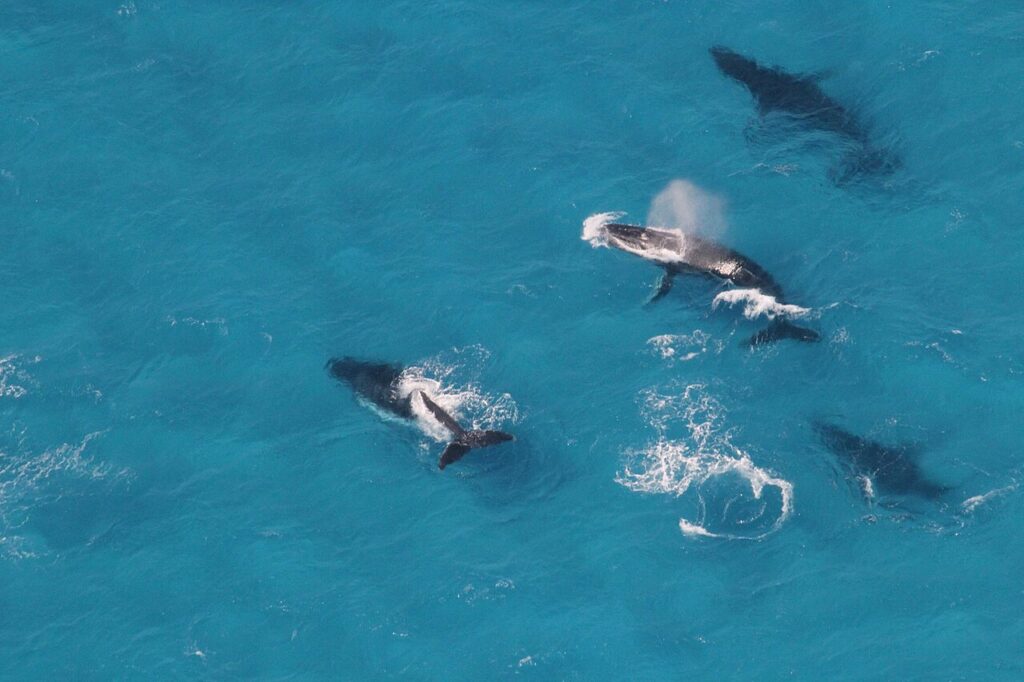
As we’ve been talking a lot about one particular whale recently, here’s some news about lots of other whales.
#1: Whales sang more easily in calmer waters
Researchers found a recording of whale song from 1949 and were amused to hear that whales sang and communicated differently in times when the ocean was much calmer than it is today. With all the noise from ships, sonar and drilling, whales have more trouble communicating these days.
Source:https://www.cbc.ca/radio/asithappens/oldest-recorded-whale-song-9.7130961
#2: Whales chat like humans
Sperm whales communicate using a series of clicks which they vary in length and pitch. Researchers have identified similarities between the patterns of these sounds and those of various human languages, including Mandarin and Slovenian.
#3: Whales butt heads like rams
Sperm whales ram objects with their heads. What was previously only a theory has been confirmed by scientific drone observations of young sperm whales: they butt heads into one another.
Source:https://www.popsci.com/environment/sperm-whale-headbutt-video
Unfortunately, there is also some less welcome news:
#4: Whales in the Antarctic are starving
Since the ban on industrial whaling in 1986, their decimated populations have recovered remarkably – only to now face a new threat. Industrial fishing is decimating stocks of krill, the tiny, omega-3-rich crustaceans found in Antarctic plankton, which are in high demand among fish farmers and manufacturers of dietary supplements and superfoods. However, krill is an essential food source for many fish, not least for whales.
The whales were once saved thanks to the ban. Now we must save them again by avoiding farmed fish of species that are fed krill or fish meal in general, and by choosing omega-3 supplements based on microalgae over those based on krill or fish oil. By the way, did you know that the omega-3 in krill and fish comes exclusively from microalgae in plankton? Why take a detour via krill and fish when you can get it straight from the source? Ask for it in your grocery store or supermarket.
#5: Grey whales are battling global warming
Grey whales migrate further than any other mammal: 10,000 km from the Arctic Ocean to the Pacific coast of Mexico and back again. For thousands of years, they have fed on plankton in the Arctic, but as the ice cap melts, plankton populations are declining. In search of food, the whales swim into waters such as San Francisco Bay, and many of them are unable to make it back to the Arctic and are eventually washed ashore. Over the last three decades, the grey whale population has been decimated by almost half to less than 14,500 individuals.
I’d like to subscribe to the think.fish newsletter
Schreibe einen Kommentar
Du musst angemeldet sein, um einen Kommentar abzugeben.