
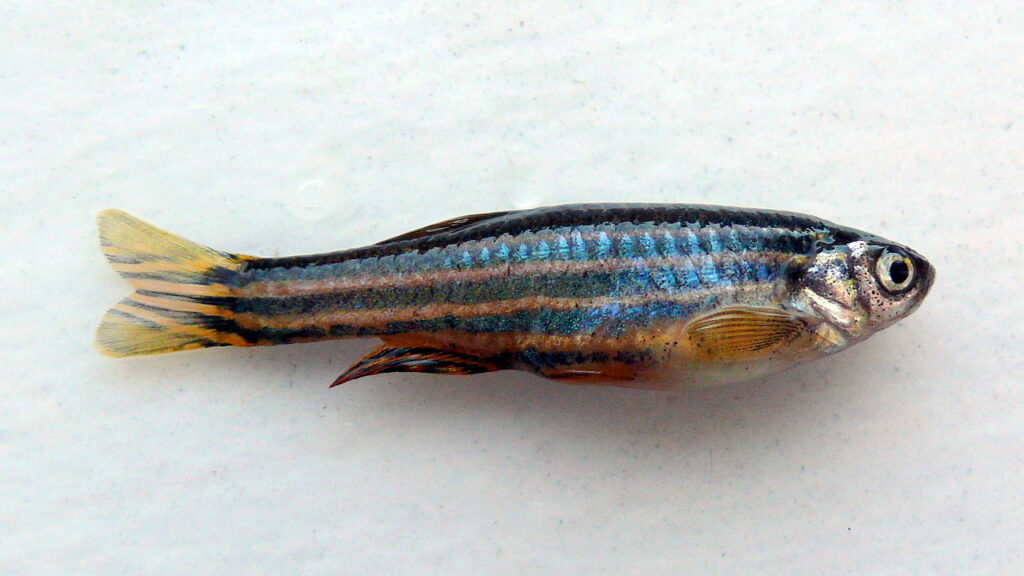
To survive, a living being must be able to adapt to its environment. A clever experiment with zebrafishes shows that a comfortable life costs adaptability.
The zebrafish (Danio rerio) is the laboratory rat of the underwater world. The species has been used for decades for all kinds of research and has reproduced under laboratory conditions for over 150 generations. Researchers have realised that this provides them with the basis for a perfect evolutionary experiment: How has the adaptability (plasticity) of laboratory fishes to changing environmental conditions evolved compared to their wild counterparts?
To test this, they exposed laboratory zebrafishes, which are normally kept at a temperature of 28° C, to fluctuations between 10 and 38° C, which corresponds to the living conditions of zebrafishes in nature. They observed the swimming behaviour, growth and other parameters and compared the results with the values of a control group of wildcaught zebrafishes.
In fact, it turned out that the laboratory fishes lost their plasticity because they no longer needed it. However, this also raises the question of who the laboratory fishes are still a model for, if they are so different from their counterparts in the wild.
First published on 15.01.2023 on the fair-fish blog (offline now)
Reference:
[1] https://www.sciencedaily.com/releases/2022/05/220527121405.htm
Schreibe einen Kommentar
Du musst angemeldet sein, um einen Kommentar abzugeben.