
Longread
On the second night of the war against Iran, on March 1, 2026, air strikes carried out by Israel and the USA thoroughly hit fishing harbours on the Iranian coast of the Gulf of Oman. More than 100 fishing boats and the livelihoods of tens of thousands of people were destroyed at once.
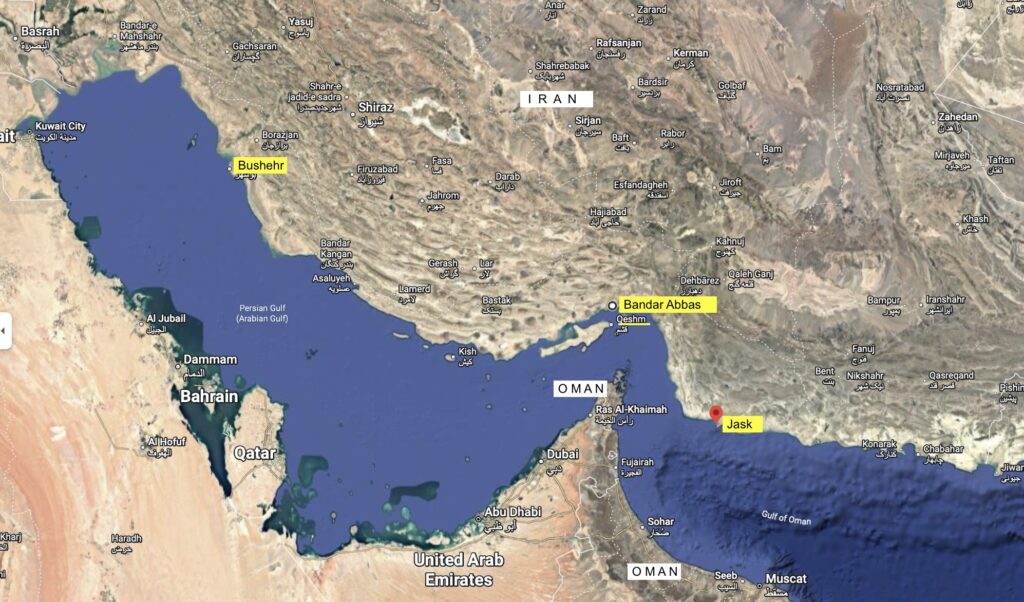
According to journalists, the strike hit a fishing pier at the port of Jask, the second most important Iranian port of fish supply for canning factories, situated southeast of the Strait of Hormus. Jask has also been a naval base of the Islamic Revolutionary Guard Corps Navy since 2013. Even if the destruction of the fishing boats might have happened as a collateral damage, for the fishermen and their families it was absolutely devastating.
The following is an edited summary of a report by Banafsheh Samgiss of the Persian Etemad Online News (based on the English translation by a local friend).
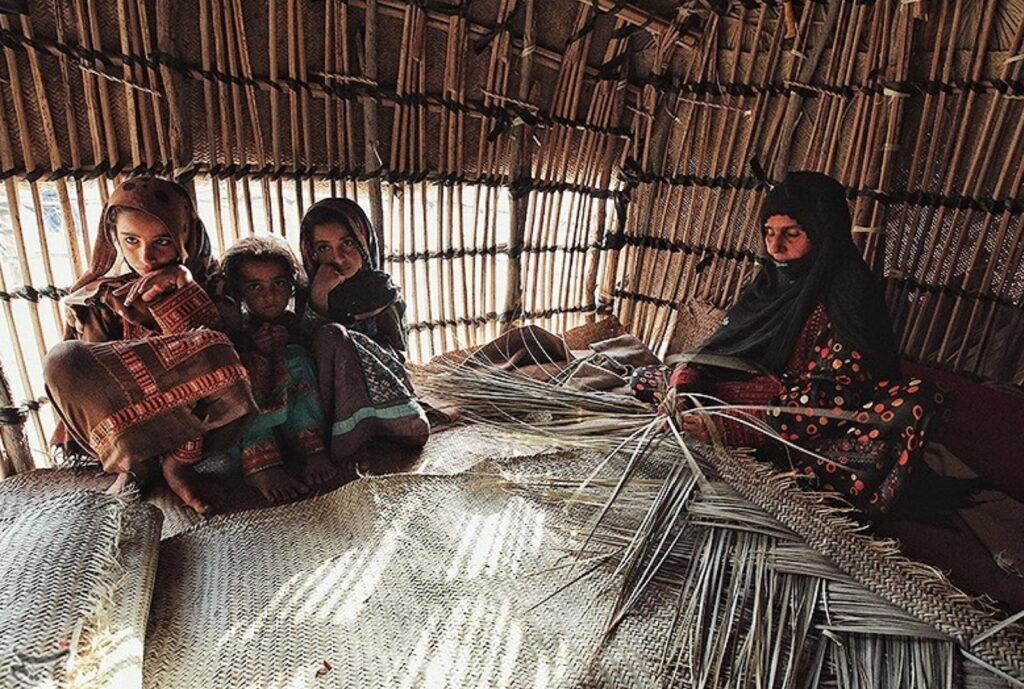
Mahmood, a fisherman at the port of Jask
Boat owner Mahmoud says: ’Hundred boats it’s just words. Seventy of those boats were deep-sea fishing vessels, each equipped with cold storage capable of holding 200 tons, and each making three voyages to sea per year. Some of the boats were the investment of two or three families. Some owners had three or four boats, and all of their vessels were burned in the fire. Some boats had brand-new engines and had never gone to sea; a few had only made two or three trips up to 700 km from the coast because they were new. ’If you went to a shipyard in Qeshm (the island in the Strait of Hormus) to have a boat built, you would have to pay 150 billion tomans (950,000 €*) — and on top of that, add the cost of nets, crew wages, captains, and outfitting the boat for long trips to Somalia and India.’
Since March 1, Mahmoud has spent at least 70 days living in Jask port and surrounding villages. During these days, officials from the Fisheries Organization (FO) and the Maritime Administration came and went, made promises, and none of them were fulfilled. The remains of the burnt boats still lay on the seabed, and no crane has come to remove them. Some boat owners suggested to the FO that, with a special permit, they be allowed to work on the unlicensed boats so that life in the area could revive. In vain. ’Of the 100 boats, nothing remains. From my boat, only a few radios survived. Everything left from my boat is only good for scrap. I bought this boat with a bank loan. Last year I finished paying off the final instalment. Starting this year, my boat would have become profitable.’
Mahmoud has a rough calculation of his debts. Just one item: 250,000 dirhams (60,000 €*) for purchasing 200 rolls of nets at the beginning of winter, when the boat was sent to sea. When the boat returned and he sold the fish, he settled 150,000 dirhams of the net’s cost. Now, combining all debts and receivables from the market, he owes around 20 billion tomans (125,000 €*) — while the sea remains ’closed’.
* Currency conversation:
1,000 tomans = 10,000,000 Iranian Rial IRR= 6.35 €
Toman is an old Persian currency, still used locally, in two versions differing by the factor 1,000. Here, it refers to 1 Toman equalling 10,000 Rial, the official Iranian currency. To give an example of how sanctions and the war destroyed local economy, my friend says 1 egg costs currently 5,000 to 8,000 Toman (which would be 31 to 51 Euro in official exchange rate). The exchange rate varies f day to day.
1,000 dirhams (United Arab Emirates) = 240 €
People in the port have large families, each household often has four or five children. For weeks now, more than 3,000 sailors and captains have been struggling just to feed their families, Mahmoud said, and he sees difficult days coming for them, days that may end in fuel smuggling, gasoline trading, and transporting goods and alcohol along the route from the port to the Pakistan border.
Ebrahim, vessel owner at the port of Jask
Ebrahim owned four deep-sea vessels. Each time he sent them to the ocean, with at least 25 sailors, he planned for at least 600 tons of fish. ’Every year they went on three long trips. They stayed for two months in the waters of India and Somalia and then returned. Before the war, all four came back. As usual, we moored them at the pier. On the afternoon of March 1, all four burned.’ When the missiles hit, Ebrahim attended a funeral, 75 kilometres from the port. ’I went onto the road leading to the pier. I was far away, but I could see the flames and smoke. I couldn’t go any closer. I sent the boys forward, but they were stopped at the entrance. Since that day, I have never gone back to the pier. My whole life was there — my whole life burned. These boats were the result of 30 years of my work. In 1994, I returned from military service. I first bought a small boat, then a coastal vessel. I took bank loans and eventually reached deep-sea vessels. Everything burned. My life was destroyed, and I was left with huge debts from nets, cold storage construction, and shipyard work. I bought two engines for my vessels from Dubai. I issued checks worth 60 billion tomans (380,000 euros)* just for the engines. Our job was to go to sea, bring back fish, and repay our debts. I lost 400 billion tomans (2,54 million €*).’
Dozens of boat owners were watching the flames from a distance. Military forces did not allow the owners to approach. The entrance to the pier was blocked. Officials from the FO and the Fishermen’s Union came to stand beside them in these moments close to collapse — men who were once the pride of the port, and now all their honour had turned to ash in the fire of war.
I’d like to subscribe to the think.fish newsletter
Like his colleagues, Ebrahim still does not know what the government will do for him. He has become depressed, and he knows it himself. Week after week passes, and he does not go into the city. He sleeps only two or three hours a day, sits silently at home for hours, and then goes to the village café. The burning of the boats is only one chapter of this disaster that has left thousands of people along the Jask coastal strip homeless and ruined. Another chapter is the cost they paid to equip the vessels—all of which went up in smoke. ’They said we might be given grants to compensate part of the damage. I had 200 rolls of nets on each of my boats. Each roll of net now costs 100 million ns, and with ropes and coverings it reaches about 150 million tomans (950 €*). The fishing business has stopped. The sea has become polluted, fish have been destroyed by pollution. Shipbuilding has stopped. Shipyards are afraid to start working. Right now, 300 vessels are left unfinished in the Qeshm shipyards, and because of fear of war they dare not complete them. There is no other job here, nothing, only the sea. For each voyage of my vessels, I used to buy one billion tomans (6,300 €*) worth of food supplies from the market. Since March, mechanics, repairmen, cold-storage technicians, electricians, plumbers, net and rope sellers have all been unemployed. How are we supposed to live without fishing?’
The wages of sailors and captains in Jask port follow customary rules. When a boat returns and unloads its cold storage, after deducting food and maintenance costs, 45 percent of the profit is divided between the sailors and the captain. All those 100 fishing vessels anchored at Jask pier that were turned to ash in the fire had arrived at shore a few days before March 1, and each sailor and captain had returned home with 140 to 150 million tomans (890-950 €*) earned from three months at sea. By end of May, those wages have long run out.
Abdullah, small-scale fisherman at the port of Jask
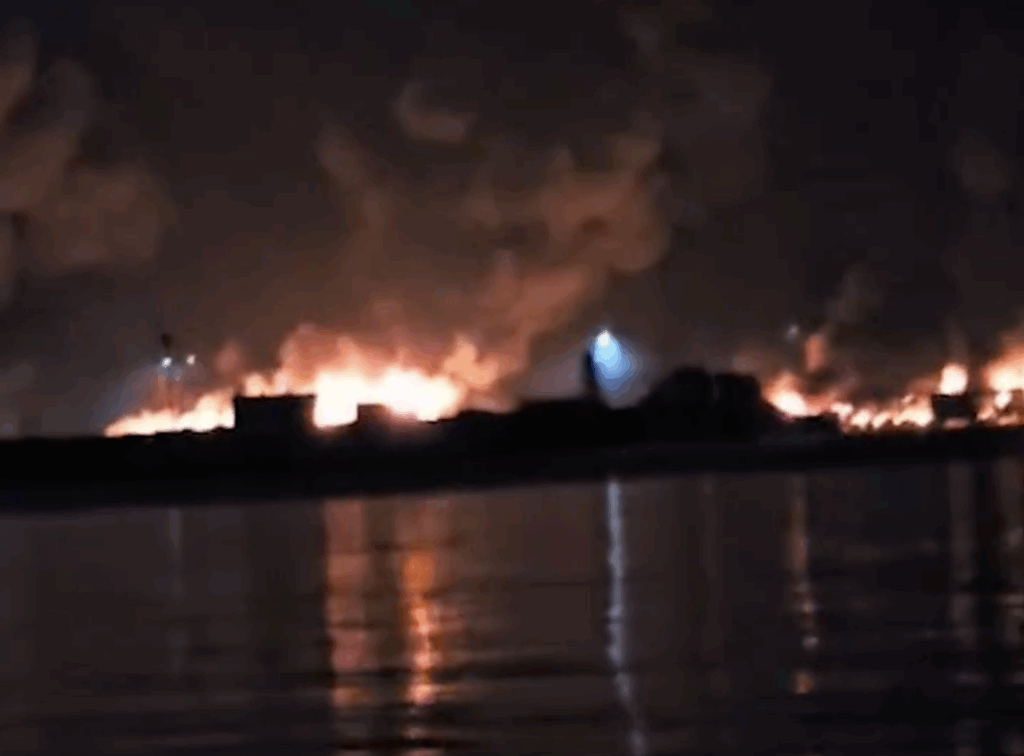
Abdullah owns a small boat with three sailors that can only go up to 20 miles off the coast of Jask. On March 1, Abdullah was cleaning the deck of his boat at the eastern corner of Jask port’s pier, when on the western side of the pier — where about 100 fishing boats were anchored — an explosion from a missile suddenly occurred. The wind was carrying the fire onto the neighbouring boats, and then — boom. It was on a day of the fishing season. In the days before, all the boats had returned from the waters of Somalia and India filled with tuna, and the crew had unloaded the cold storage holds. Containers carrying 10 to 20 tons of frozen fish had been loaded for shipment to canning factories.
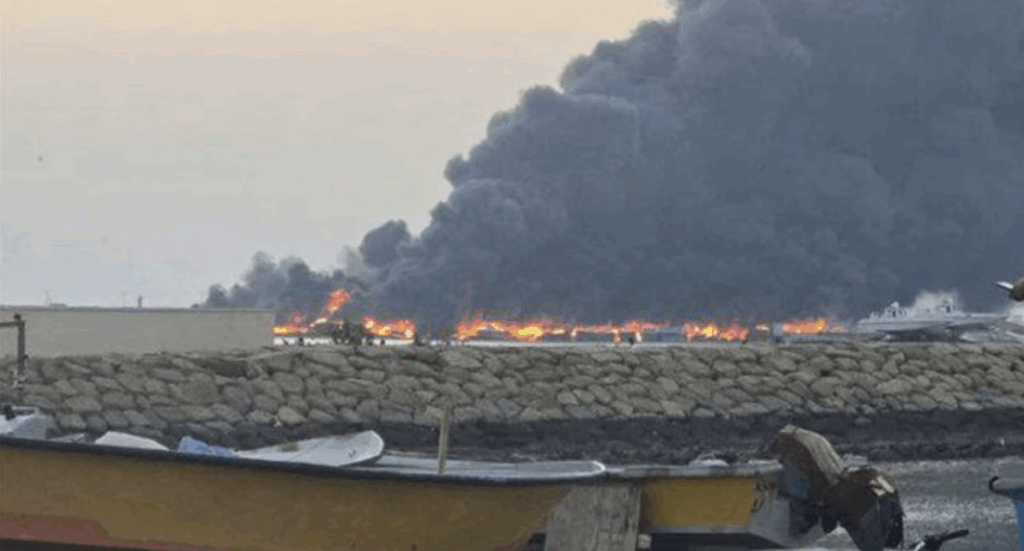
When the western side of Jask port was hit by a missile, the boats were empty of crew and fish. The air was filled with the smell of burning plastic, wood, and metal. Thick black smoke swallowed the sky over the pier, and towering flames were burning everything on that side. They burned for four days until they were completely destroyed. For four days, the sky over Jask port was black. Jask port was sealed off and the sea was closed. Along the coastal strip, no boats or vessels were allowed to enter the water.
At sunset on Mach 1, the fisherman at the port of Jask were crying. They had come from villages as remote as 900 kilometres, traveling through difficult mountain routes to reach the port and look for their boats. Without boats, there is no bread — neither in Jask, nor in all the villages they came from. Each sailor had been nourishing a whole family. Abdullah stood for four days behind the yellow tape that had been placed around the port and watched as boat owners, devastated and in tears, came to witness the burning of their livelihoods. After those four days, no one came anymore.
After the attack, ’ the sea was closed’, Abdullah said, no boat was allowed to enter the water along the Hormozgan coast surrounding the Strait of Hormuz . ’It’s not like one vessel is lost and another replaces it’, as Abdullah said. ’With the burning of so many boats, many people have no job for a long time. Life here is extremely expensive, not what you see in Tehran or Isfahan. There are no jobs here. There are no factories, no agriculture, no livestock farming. Life in our region is tied to the sea. Without the sea, life in the entire port and its surroundings comes to a halt.’
Abdullah and his family stayed in the city. They stored enough water and food and two sacks of flour to last two months and remained there. Abdullah did not go to sea for 70 days. Even when he went in May, he returned empty-handed because there were no fish in the sea. The war drove the fish away, and both fishing boats and coastal vessels were returning empty.
Two types of fish come from the waters of Jask: horse mackerel, which is exported and reaches China, and cheaper fish for local consumption or shipment to Minab markets and other parts of the province. From mid-winter to late April is the fishing season, but last winter, fish were already scarce, then two months of war followed, and when April arrived, there was no fuel, boats were immobilised, companies were not buying fish, and now the coastal region has been left hungry.
Abdullah speaks of fishermen who, because they had no fuel for their boats, sold valuable household items just to feed their families. He also speaks of coastal boats that, before the war, would always bring a few kilograms of sardines alongside their main catch. These cheap sardines were allocated to poor women and children who had no means of fishing themselves. The boats would give each woman and child 10 kilograms of sardines to take to Minab market and sell for 10,000 to 15,000 tomans per kilo (0,06-0.09 €*), giving 2,000 to 3,000 tomans back to the boat owner and keeping the rest as income. During these 70 days that the sea was shut down, these women and children also went hungry. ’When the sea sleeps, the city and the market shut down. A sailor who has no money no longer buys anything.’
Mim, fisheries equipment merchant at the port of Jask
Mim is an employee of a fishing equipment supply company in Jask. He says that his company has been earning absolutely nothing since March, because fishermen cannot go to sea due to the rising cost of fishing equipment. ’The fuel for coastal fishing boats is gasoline, and now gasoline is scarce. Only licensed boats receive fuel quotas, but along the entire Hormozgan coast, only 5 out of 100 boats are licensed. Boats without licenses must buy fuel from middlemen at 10,000 to 15,000 tomans per litre 0,06-0.09 €*). Each boat must stay at sea for at least one full day for fishing, and for each trip it needs three 60-litre jerrycans of fuel. For each container, two cans of oil must be added. The price of each oil can has risen from 180,000 to 550,000 tomans (3.50 €*). The price of bait has reached 150,000 tomans per kilo, and each boat must carry at least 10 kilos of bait. Previously, fishermen could buy food and water for a two-day trip for about 2 million tomans, but now it costs at least 6 million.tomans (38 €*). One day of fishing now costs at least 14 million tomans (89 €*) per boat. These coastal boats catch horse mackerel. Before the war, fishing companies paid 330,000 tomans per kilo, but now they buy it from fishermen for 250,000 tomans (1.60 €*).’
Mim knows more than 150 fishermen in Jask, none of whom have gone to sea since last March. He says there are at least 4,000 coastal boats in Jask, all of which have been inactive since that time. He also speaks of dozens of boat and net repair workers who have had no customers since then, and of transport vehicles that move boats from shore to dock that have not transported a single vessel since March. In total, he says at least 10 professions along the Hormozgan coast have been left unemployed due to the ’sea closure’.
With these high fuel and equipment costs, a fisherman must bring back more than 100 kilos of fish per trip just to break even. Those who return with 10 kilos come back in debt. Families wait for two days hoping the fisherman will return with food, but instead he returns in debt. Mim knows fishermen who are willing to go to sea despite the high fuel and equipment costs, because they have no other way to support their families. They buy fishing gear on credit and instalment plans, hoping to pay off their debts after selling their catch — a kind of gamble on the unpredictable sea, which sometimes gives 10 kilos of fish and sometimes 300.
’A fisherman tells me he cannot let his family go hungry and must bring something home. If their boat engine breaks, they must pay 100 million tomans (635 €*) just to open and repair the engine. Coastal boat hulls are made of fibreglass and can shatter with the slightest impact. Now each small piece of fibreglass repair costs at least 25 million tomans (160 €*).’ Mim knows a fisherman with four children who was renting a house and sold his boat end of March at half price to cover household expenses. After the ceasefire, he bought a small boat again, and now goes fishing without a sailor and without food reserves — which is essentially suicidal, because no fisherman goes to sea alone.
’Across all of Hormozgan, 90 percent of boats are inactive. Export companies dealing in horse mackerel announced in May that their warehouses are full, and because the port is closed and exports are impossible, they can no longer buy fish. With this situation, even the remaining 10 percent of boats that still went to sea can no longer operate, because there is no one left to buy their catch.’
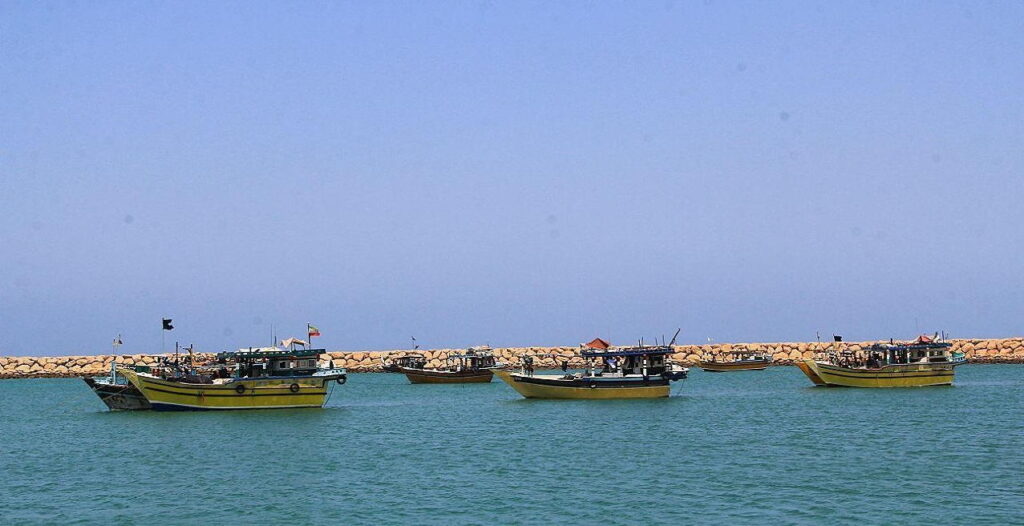
Ghafoor, impoverished fisherman at the port of Jask
On the classifieds site ’Sheypoor’, searching for Jask and boat listings reveals numerous ads for boats, engines, and coastal vessel equipment. Most ads are from May — old and new engines, damaged hulls, factory-painted boats, coastal vessels with 200–300 kg storage tanks. The tone of the ads is a silent plea: ’Just buy it, I’ll agree to any price. Just buy it.’ These ads themselves are like a declaration of ’sea closure’, if interpreted as the sea’s withdrawal from Jask. One ad is for a boat priced at 75 million tomans (450 €*).
Ghafoor, the owner, lives in the village of Hosseineh in Bandar Lengeh, at the coast wets of Qeshm island, where everyone’s livelihood depends on fishing. He says this coastal village has 1,500 fishermen, all of whom have been unemployed since March. Ghafoor himself is one of them, and this is why he has put his boat up for sale. It is not that there are no fish — the sea near Hosseineh is full of horse mackerel — but the cost of fishing has become so high that nothing remains for the fisherman. ’Now we have to go to sea with gasoline costing 20,000 tomans (0.13 €*) per litre. Before the war, it was 5,000 tomans, and we used 150 litres per night of fishing. We don’t have licenses, so we don’t get fuel quotas. Each litre of oil for the boat engine now costs 500,000 tomans , and each trip requires four one-litre cans. They buy horse mackerel from us at 180,000 tomans per kilo, whereas before the war it was 330,000 tomans (3.20 €*). Nothing remains for us. Many fishermen are selling their equipment. Our lives are falling apart. We are forced to change our jobs, but we don’t know any other work. We have worked on the sea since childhood, and now we don’t know what to do.’
Ghafoor and all fishermen are afraid of the sea these days. They fear that a drone might fall on them. A few weeks ago, several sailors were killed in exactly this way. They had gone fishing when a drone struck their boat, and rescue teams collected their mutilated bodies from the water. Horse mackerel fishing takes place at night; in the darkness of the Persian Gulf, powerful floodlights must be turned on, bait is attached to hooks, and the lines are lowered into the deep. The fear is that these bright floodlights may act as a signal for drones. The sailors whose bodies were recovered from the water had no insurance. Many of the crew members from the boats that burned in Jask pier also had no insurance. Fishermen in Bandar Hosseineh and Jask, because they lack official licenses, also have no insurance. And the meaning of all this lack of insurance is that in moments of poverty and crisis, they have no support at all.
’Now, has anyone bought your boat?’ This was my last exchange with Ghafoor. —’No one. Why would anyone buy it? Whoever buys a boat wants to work. When there is no fuel, who would buy a boat?’
Maqbool, vessel owner at the port of Bandar Abbas
Maqbool, a large-built man, owner of a fishing boat, came from a distance and got out of his car at the port of Bandar Abbas (Iran’s main trade and naval port at the Strait of Hormus). The crackling of flames could be heard. He told his son: ’My legs don’t have the strength to go any closer. Take me home.’
Maqbool’s boat had arrived at the coast of Jask on late February, 35 sailors and their captain had returned after three months of riding the waves of the ocean, bringing back 160 tons of fish. The boat’s cold storage was emptied in just one day. The sailors were in a hurry to get home. They were poor men who endured two or three months of hardship at sea and the danger of encountering sea pirates, so that with the wages they earned they could return home with full hands, like many men, fathers, and sons. This time, Maqbool could use the sale of all that fish to the canning factories to settle several hundred million tomans* of debt to companies that manufactured nets and supplied equipment for vessels. Maqbool’s boat was one of the giants of Jask, equipped with engine, generator, communications systems, and a large cold storage that could travel up to 2,500 kilometres from shore.
Last year, Maqbool spent 25 billion tomans (150,000 euros)* rebuilding the nets, engine, and cold storage of this 17-year-old vessel. When he sent it back to sea at the beginning of winter, it was like a celebration for him. After discharging the catch in late February, the ship continued to the port of Bandar Abbas for engine cleaning and maintenance. There, his boat burnt on the fourth night of the war, hit by missiles like two nights before in Jask.
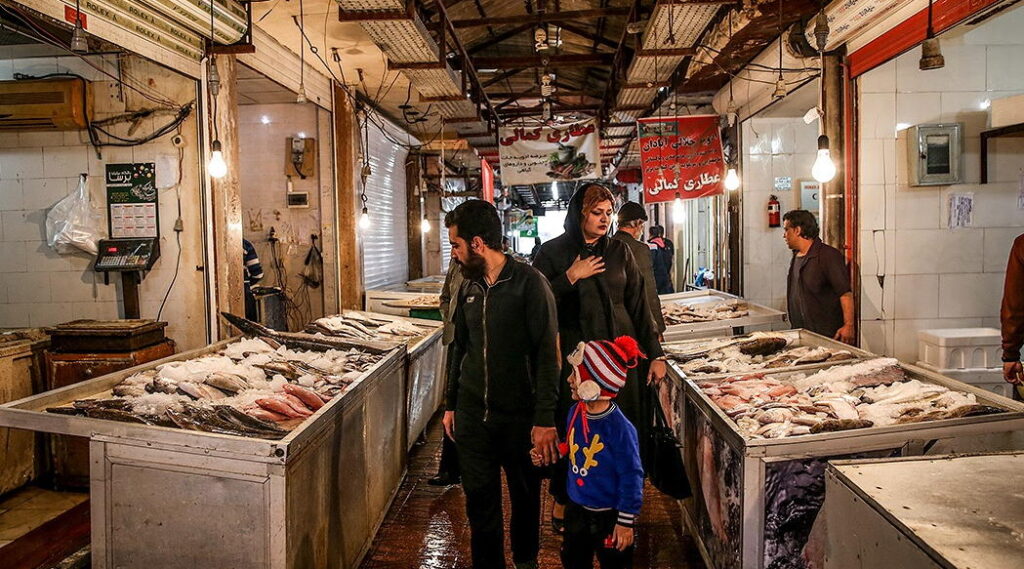
Bushehr: lost markets
The following is an edited summary of a report by Tannaz Hoseinifar of Fararu News (based on the English translation by a local friend).
On an early morning in June Abu Reza, a captain of a fishing vessel, sat on the pier in Bushehr at the Persian Gulf and lit a cigarette. His fishing boat was there; but the sea was no longer the same as before. The sea had changed for the fishermen of the south — like when it ebbs and people don’t realise when the water has gone down! After the ceasefire had been announced, fishermen who had neither insurance nor financial support were forced to return to the sea with their old boats. But during the months of war, they had lost their markets; competitors from abroad had already taken their place. What happened?
Abu Reza believes that the economic consequences of the war for residents of Iran’s southern coasts have not ended even after the ceasefire. ’From the very first days when the war reached the sea, it brought significant changes to the coastal economy. In fact, the ceasefire did not reach the sea.’ According to him, during the war days, a significant part of the fishing fleet’s activity was suspended and many fishermen were not allowed to go to sea. Although restrictions were reduced after the ceasefire, returning to normal conditions was not easy. ’After the ceasefire, it was announced that any fisherman could resume activity at their own responsibility. In reality, they had to accept unsafe conditions. On the other hand, most sea-related jobs are not covered by insurance, so unemployment benefits are also ruled out. In fact, they were not supported by the government or the Fisheries Organization, which forced fishermen to continue working.’
However, the main challenge is not only the risks of going fishing. According to Abu Reza, a significant part of the traditional southern seafood market — especially products such as king prawn — was located in Arab countries along the Persian Gulf; a market that was effectively disrupted with the start of the conflict. ’Those who went out to sea and previously caught specific fish such as king prawn lost their main market across the Persian Gulf. But as soon as the war began, communication with Arab countries along the Gulf was significantly cut off.’
Disruptions in exports, according to people active in this sector, have also affected the distribution chain and pricing of seafood products. ’Now middlemen say that previously they sold products at higher prices to Arab countries, but now it is the domestic market, so the prices placed on seafood products are lower.’ However, local fishermen and captains emphasise that a decrease in producers’ income does not necessarily mean cheaper prices for consumers, and the price of many types of fish and shrimp is still on an upward trend in the domestic market.
As a result, the recent war, in addition to its political and security consequences, has also affected the long-standing economic relations between southern Iranian maritime workers and the countries of the Persian Gulf, and has reduced part of the region’s job market. Referring to financial pressure on boat owners, Abu Reza says: ’A captain who used to go to sea with 15 crew members now goes with 10, because up to now he has had to pay wages out of pocket, and after nearly four months in this situation, savings are running out.’ This also shows the shrinking of the business despite the same amount of effort for fishermen.
A damaged network of trade
Fishermen and economic actors in southern Iran say one of the most important consequences of recent months’ tensions has been damage to a network of trade relations that had developed over years between southern Iranian ports and countries along the Persian Gulf. In this context, the United Arab Emirates — which had previously been one of the main destinations for Iran’s seafood exports — has gradually distanced itself from its former level of engagement. According to stakeholders in the sector, this has led to stagnation in parts of maritime trade, a decline in cross-border exchanges, and increased uncertainty in the local economy of the southern coasts.
Khansir, an exporter in the fisheries sector based in Dubai, states: ’Previously, fresh fish from Bandar Lengeh, Qeshm, and Kish would go to Dubai, but now this flow has almost stopped. In the Persian Gulf region, Dubai was the most important market for Iranian seafood. Exports to Qatar, Kuwait, and Saudi Arabia have also gradually decreased and stopped over the past years.’ Khansir explains that part of Iran’s exports included farmed fish and farmed shrimp, which were re-exported from the UAE to other regional markets. According to him, restrictions on re-export through the UAE and the entry of new competitors — especially shrimp producers in Saudi Arabia — had already affected Iran’s share in the regional market even before the war, but recent developments have made the situation more difficult. On the other hand, Oman has also entered the Iranian fish market as a competitor. Meanwhile, some economic actors believe that even after regional calm returns, Oman is likely to remain in this market. ’In the current situation, practically no fresh or frozen fish from Iran enters the ports of the UAE. Only a portion of farmed shrimp is exported to Oman, which is mostly not for Oman’s domestic consumption, but is re-exported from there to other markets.’
Fisheries stakeholders believe the importance of the UAE market is not limited to trade volume. Dubai, with its large tourism industry, hotels, and restaurants, is one of the most important regional hubs for consumption and distribution of seafood. Therefore, continued disruption in trade between Iran and the UAE could lead to the loss of part of Iran’s traditional share in this market — a share that, if replaced by competitors, would not be easy to regain even after political tensions ease.
An Iranian professor advocates national capitalism
Kiomars Eshtehriyan, a professor of political science at the University of Tehran, raises the issue of ’restructuring governance in the fisheries industry: ’The main idea is that by restructuring governance in the fisheries sector, we can solve part of the problems. Governance restructuring is not an economic theory, but rather the organisation of entire value chains in this industry by a few large firms, which we refer to as Iranian capitalism. Through the formation of these chains, small units in the industry are placed in a safer position. Eliminating intermediaries, reducing final costs, increasing productivity, and providing stability for small units through long-term contracts are among the outcomes of this model.’
Eshtehriyan describes the current situation of traditional fishermen: ’We are seeing hundreds of small boats, thousands of dispersed fishermen, and numerous intermediaries in ports, cold storage facilities, transport, and exports. Each intermediary takes a share of the profit, and the final fisherman faces minimal income and high risk. It seems that several large private companies should organise the entire fishing value chain.’ And he continues: ’In input supply, imports are currently fragmented and expensive, which could be addressed through integrated bulk procurement. In the fishing segment, personal boats operate with individual responsibility, which could be stabilized through long-term contracts with fishermen. In unloading and storage, multiple cold storage facilities operate with high fees; the solution is to create dedicated aggregation and processing centres. In transport and exports, intermediaries are numerous, making logistics integration necessary. In domestic and foreign sales, the market is volatile and sanctions remain restrictive. Therefore, branding and organised export are essential. In this approach, fishermen are not eliminated; rather, they are integrated into the chain with job security and fixed income. The cost of fish and shrimp decreases. Bargaining power against sanctions and currency fluctuations increases.’
Eshtehriyan’s ’Iranian capitalism’ approach embraces also the transport sector with hundreds of thousands of owner-drivers of heavy trucks, hundreds of small transport companies, and numerous intermediaries which consume a large share of drivers’ income. He proposes ’the formation of several large transport companies that provide integrated services including insurance, cargo, maintenance, and support’. If this model is extended to southern maritime transport, it would mean that 5 to 10 large private companies would integrate the entire maritime logistics chain (boats, fuel, insurance, loading, unloading, customs, and inland transport). They could sign bilateral contracts with ports in Oman and the UAE and reopen trade routes without waiting for state-level negotiations. Small boat owners, instead of facing unfair competition, would operate through contracts with these firms. As a result, transport costs would decrease and alternative trade routes would emerge to bypass sanctions.’
According to Eshtehriyan, ’the only thing the state should do is not interfere; meaning it should remove state monopolies in ports and customs and avoid unnecessary intervention and rent distribution. However, the state can play a role as a guarantor of contracts between small units and large companies. Neither direct state intervention in fisheries (such as subsidised fuel or price controls) nor rent distribution among small boat owners is the solution. Instead, the desirable option is creating an environment where a few large firms can organise the value chains without interference.’ For Eshtehriyan, the main problem is ’the lack of theoretical self-awareness in the administrative and policymaking system. That is, the belief that the solution lies in enabling national capitalism has not yet been institutionalised. Until this mindset becomes the dominant discourse in governance and administration, structural reforms will progress slowly. In other words, transformation requires a shift in discourse at the macro level of governance, not just local operational programs’.
Personal comment to professor Eshtehriyan’s theory:
Centralisation of production, logistcs, and commerecialisation can have detrimental effects on small-scale fisheries, as the example of forced co-operatisation in northeastern Germany has shown [1] – or it can fail by opting out of fthe ishermen in the example of Senegal [2].
[1] Billo (2009: Kleine Fischer in Deutschland unerwünscht?
[2] Aliou Sall (2002): An Essay on Fishworkers’ Organizations in Senegal
Schreibe einen Kommentar
Du musst angemeldet sein, um einen Kommentar abzugeben.