
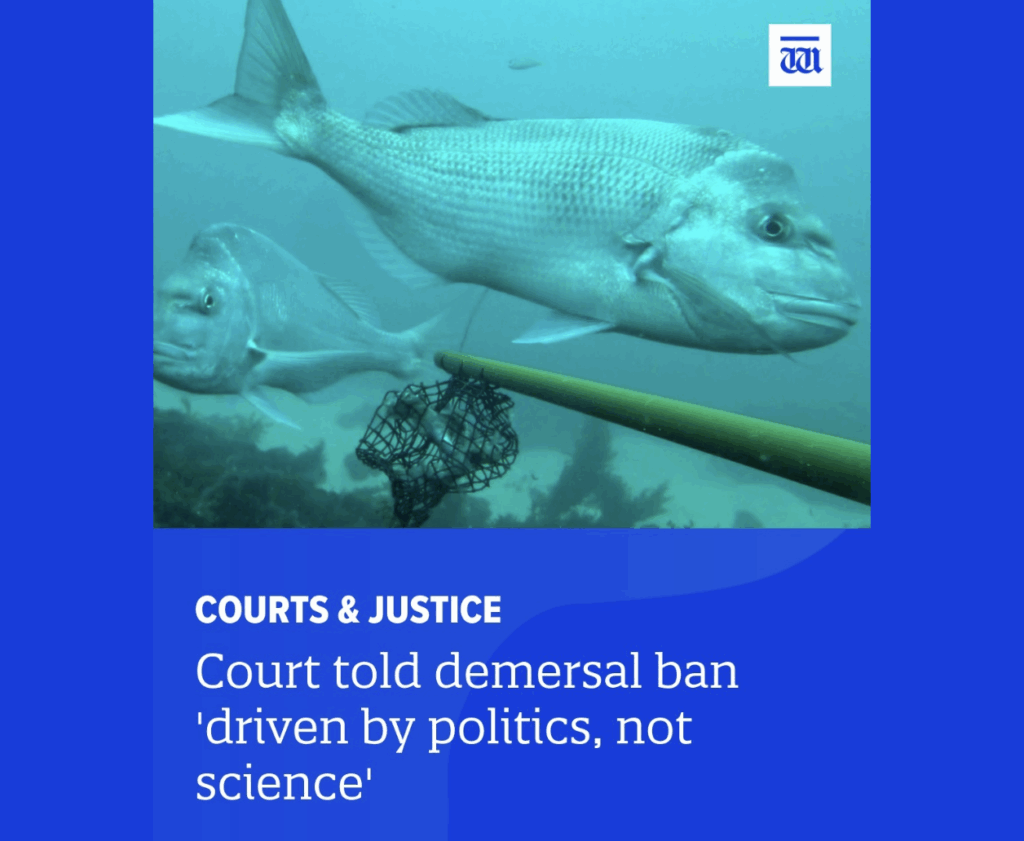
Governments are often criticised for failing to follow scientific advice when setting overly generous fishing quotas. But what if authorities, driven by political campaigns, disregard scientific findings — in the opposite direction?
The Western Australian Department of Fisheries had imposed a permanent ban on commercial fishing for prized demersal species such as Pink snapper, Red emperor, and Dhufish along much of the state’s coastline.
The ban is currently being challenged by two trawler companies in the Supreme Court. Their lawyer argues that ’the order made by the minister was unreasonable and a disproportionate use of power’, that he had ’acted hastily while under pressure from conservationists’, and that he was ’obsessed with dolphin by-catch from trawling and influenced by political considerations’. [1, with thanks to Roy D Palmer]
The court has not yet ruled.
In general, the plaintiffs are right: fishing restrictions must be based on sound scientific evidence, not on political opinions. However, this could backfire on the industry in the future when scientific studies [2] will show that trawling is one of the fishing methods where the high level of animal suffering it causes cannot be significantly reduced.
I’d like to subscribe to the think.fish newsletter
References:
[1] https://au.news.yahoo.com/fishing-ban-plan-political-unscientific-064500140.html
and https://www.parliament.wa.gov.au/hansard/daily/lh/2025-12-03/26
Schreibe einen Kommentar
Du musst angemeldet sein, um einen Kommentar abzugeben.